During the break my husband and I had a week's holiday in Australia where we drove to what felt like the middle of nowhere - a place called Arkaroola in the Flinders Ranges. Amazing trip. Now back to 'facilitation online' - not quite the 'middle of nowhere' anymore!
I listened to George Siemens lecture on Curatorial teaching/learning and thought I'd have a go at embedding a presentation of my notes - trying to use some of the tools highlighted earlier in the course.
First I had a go with the Google Docs presentation tool. Easy to make the presentation but then couldn't embed it. Here's a link to the presentation though.
So copied slides into PowerPoint and then uploaded to a new Slideshare account. Spent a while searching around for information on how to embed the thing (I'm at work so can't view YouTube videos for help). Eventually managed the following. It's boring old text but you've got to start somewhere :)
I liked the idea of curatorial teaching and it reminds me a bit of the initial web quest activities where the teacher pulls together useful links and gives the students activities to complete using those resources. The 'curator' now has many more resources to access in order to create an exhibition - blogs, wikis, videos, presentations, email groups (i.e. Web 2.0 material).
In secondary teaching there are usually learning objectives that need to be achieved by students and often learning activities lead the learner down a path towards that goal. I wonder if this 'exhibition' approach would be difficult for learners at this level - i.e. not enough structure. But perhaps such 'exhibitions' could help students develop experience/skills in 'how to learn'. As with other learning activities it will come down to the skill of the teacher in setting up the activity.
One last thing. Whilst listening/watching the download of the lecture, one of the participants (didn't make note of name, sorry), kept a running commentary on what was being said in the chat tool. Very helpful, thank you!
Monday, 15 October 2007
Middle of Nowhere

Sunday, 16 September 2007
Catching Up!
Ok, there are four things I want to catch up with from the last couple of weeks. [Before I go on holiday and have to deal with the backlog of emails/posts/wiki edits that will no doubt build up ;)].
- Sheryl Nussbaum-Beach's lecture on the Art of Building Virtual Communities.
- Our failed Elluminate lecture.
- Using Skype.
- Setting up a wiki page.
Listening to Sheryl's talk revealed another person who is very enthusiastic about participating in online learning communities. She talked about teachers as 'models for students' working as partners in equal participation using the 'power of the collective intelligence' available through the Internet. Sheryl's enthusiasm compares to that expressed by James Farmer, Nancy White and Konrad Glogowski but I found an interesting read by Gary Stager who wrote a post called "Why Teachers Don't Use Web 2.0 - an historical perspective" which in the face of all the 'enthusiasm' expressed about Web 2.0 tries to address why teachers are not so enthusiastic about these social online tools. (I subscribed to an email newsletter from George Siemens site and in following links to his blog on connectivism I ended up at Gary's blog). As someone who enjoys exploring the benefits of technology as a teaching/learning tool I've always been a bit disappointed by colleagues who were reluctant to even try them out but Gary's post identifies some of the reasons for this reluctance.
- Firstly, as the software failed I assumed I was doing something wrong and I got quiet irritated that I was missing the lecture and that I would have to find time later to listen to it - it didn't occur to me that it was a technical issue! I imagine a lot of students would feel this way and that could lead to negativity towards this kind of learning.
- Secondly, I decided in future I would try to log in a bit earlier as if there were difficulties at my end, I would then have time to try to do something about it and still be ready for the start of the talk.
- Thirdly, if facilitating the session, have a contingency plan in place in case the technical fault is not mine. We all went to the email group and created a contingency in Skype. With a class of school children it would be possible to take the lesson back to a face-to-face activity. If this was a distance learning activity then we could fall back to discussion tools (skype, google talk, MSN) but I think this would need to be highlighted to students before the timetabled event started.
My wiki page on blended learning is set up. I'm looking forward to adding some content as it will have some relevance to my teaching experience. It was interesting that between setting it up at work and then coming home to work on it some more, someone had edited it. I like the collaborative nature of this and look forward to using this tool with students. I can see that some guidelines would need to be set up for working online this way, but this is no different to group work in the class. I think the ability to track contributions would hopefully deter any silliness or online 'vandalism' that can occur.
PSI couldn't make the barn building discussion on Monday night or the George Siemens lecture and I see in the email forum a discussion has sprung up about our 'community'. The asynchronous nature of this course means that we all access the forum/blog/wiki at times convenient to us and this could make it difficult to build up effective dialogue. Although it seems that posts that offer some kind of contentious statement get more responses than others that offer up links or information. I find that sometimes there is nothing more to add that would be of interest so don't bother! The lurker in me likes to read, digest and think and by the time I've done that the discussions have moved on :) I do think that a community is forming and as in face-to-face classrooms it just takes a bit of time for everyone to become familiar with each other.
Monday, 3 September 2007
Learning over the shoulder
I listened to Nancy White's lecture on learning 'over the shoulder' and here are some of my thoughts.
- Very impressed with Nancy's ability to multi-task between giving presentation and responding to the 'chat' going on in the text area. I was trying to imagine giving a talk in that way (and no, I'm not volunteering ;) and thought how tricky it would be to keep 'on task', maintain control of the technology, think about the audience and their technological expertise, respond to comments and complete in 10 minutes! I'm sure it comes down to practice (as with all forms of 'presentation'!) but still impressive.
- I went for a little surf from blog to blog - can't remember where I started but I ended up here and a discussion about using twitter in the classroom. The use of this tool was raised by Nancy in her talk and I went to the twitter site for a brief look around. My initial thought was 'nah, I won't use that' but the few examples identified in Darren Kuropatwa's blog discussion have made me think again. I find that when I learn about new online tools (such as those described as Web 2.0) I can picture their use with higher education students (or adults in general really) but I instantly put up barriers at the thought of using them with children. (I think like Mark Greenfield (in his recent post) that these tools don't always allow for 'control and direction' which is what I'm used to when teaching). However, the more examples I read the more possibilities become apparent. [Note to self: must stop thinking 'but that won't work with kids'].
- Sharing a workroom with colleagues has always led to 'over the shoulder' learning in my experience and I love the idea of being able to remotely gain technological help. This week I asked the ICTS department to give me access to Elluminate from a work computer so that I could catch some of the online lectures 'live' and a lovely tech guy took remote control of my PC, and guided me through the process of setting it up through a little chat tool in the corner of the screen. He logged off once I was happy that it was working - well, we'll see tomorrow if it actually works! But, I thought this was a nice, related example and it worked well - it saved him the 30 minute journey to the classroom for me to look over his shoulder for real!
- Also, when I was teaching ICT I found that some learner's would know far more than I would about all the available web sites, tools, software etc. The beauty of having interactive whiteboards linked to the internet meant that the whole class could learn over their shoulders.
Thursday, 23 August 2007
An Online Social Presence
Our task is to offer up some light-hearted cartoons/sound bites/jokes in an attempt to help build a 'social presence'. This was fun and far less taxing on the old grey matter but I wondered whether this was an effective starting point for creating this social presence.
So where do I start with this thought? Well, firstly I looked back at some notes I took while listening to Konrad Glogowski's lecture on 'classrooms as third places'. Konrad explains that the term 'third place' was coined by Ray Oldenburg (1989) to describe social spaces distinct from home ('first place') and work ('second place') as a place where people meet informally to socialise. (My question at this point is where does school/college/university fit in - does education count as work or as informal socialisation???).
Anyway, at this point our task looks like a bit of informal socialisation - similar to Konrad's first key attribute where he encourages students to express themselves outside of the course currculum with personally relevant content. To some extent the task also enables us to display a 'personal stamp' - i.e. by demonstrating our sense of humour - which Konrad identified in his second key attribute as a means of building a 'web presence'. Konrad's third key attribute suggests that 'any participation' is welcome as this helps build 'sociability'. And hence a 'social presence'? Yes, I reckon so. The fourth key attribute of 'the classroom as a third place' relates to the teacher's promotion of 'all activity' generated by the learners - so I suppose we'll see how Leigh & Bronwyn respond to our joke selection! So, although the task is a contrived one it does enable a little bit of personality to come through. Taking this forward with Konrad's view - of allowing learners to express themselves with whatever interests them as a means of building a community - it makes sense that over time a 'social' or 'web' presence would result.
My one reservation though is this. If I had been given the freedom to try to display my sense of humour in any way that I liked, would I have found the task as fun or did the structured nature of the task (i.e. find a cartoon, find a joke, find a soundbite) actually enable me to get on with it and produce something I was happy with? I think this comes down to my slow realisation that I'm clinging to my traditional learning patterns which is interesting as I browse through the report on e-learner profiles (link provided by Bronwyn in the googlegroup forum). The report mentions, among many other things, that a debate exists about whether learner 'preferences should be accommodated (matched) or deliberately not accommodated (mismatched)' to enable effective e-learning (page 7). By not meeting learner preferences, he/she will be forced to develop new ways of learning. How does this effect how I would facilitate an online group? Err, that will take a bit more thought!
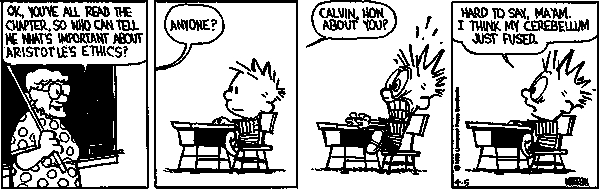
Well enough of the rambling! Here are links to some Calvin & Hobbes cartoons that make me smile.
- http://www.cooperativeindividualism.org/calvin-on-scientific-law.gif
- http://www.sivacracy.net/archives/calvin.jpg
- http://academics.triton.edu/uc/calvin_hobbes_aristo.jpg
Using Graeme's post as inspirition for my jokes search, here are some excuse notes from parents taken from:
http://www.guy-sports.com/humor/jokes/jokes_school.htm
- My son is under a doctor's care and should not take P.E. today. Please execute him.
- Please excuse Lisa for being absent. She was sick and I had her shot.
- Dear School: Please exscuse John being absent on Jan. 28, 29,30, 31, 32, and also 33.
- Please excuse Gloria from Jim today. She is administrating.
- Please excuse Roland from P.E. for a few days. Yesterday he fell out of a tree and misplaced his hip.
- Please excuse Ray from school. He has very loose vowels.
- Please excuse Jimmy for being. It was his father's fault.
A short sound bite from Homer Simpson at
http://humor.about.com/gi/dynamic/offsite.htmsite=http://www.geocities.com/jtrevolt/
[I couldn't link to the exact clip but I liked the Computer one].

source: http://www.flickr.com/photo_zoom.gne?id=34873454&size=s
Tuesday, 21 August 2007
Identity & Ownership
I listened to the recording of James Farmer's lecture on Indentity and Ownership from last Thursday and came away with the following.
- Using bulletin boards/forums are useful for individuals to express a view or seek help on a specific issue but are less conducive to effective discussions. (As shown by our 'persona' task perhaps).
- Learning management systems (which can include bulletin boards) have been developed in response to teacher's needs to deliver content online and not necessarily as as an aid to communication. Hence LMS are not always successful in creating communities.
- Blogs, on the other hand, enable effective communication to exist which can be recorded, archived and shared easily. A blog also gives the 'teacher' a chance to create a 'social presence'.
LMS/Bulletin Board | Blog | |
| Identity |
|
|
| Ownership |
|
|
My experience with Blackboard (during previous papers on this course) leads me to disagree to a certain extent. Through some extensive posting and discussion (including 'real' life stuff) there were some very strong identities created. Group tasks which resulted in a concluding post led to quite a bit of discussion especially when the activity was being assessed! However, the ownership issue is apparent as once access to the course LMS is removed there is a lot of work lost - unless you were organised enough to make copies of everything. Did we create a community? By the end of the paper I think we did. Will the blogs be more successful? My impression is that one blog as the 'strong coherent hub' (James' term I think) could be, although at present it still feels like a muddle (emails, googlegroups, blogs). With a bit more knowledge about RSS I'm hoping I can grasp the idea of creating a 'hub'!